
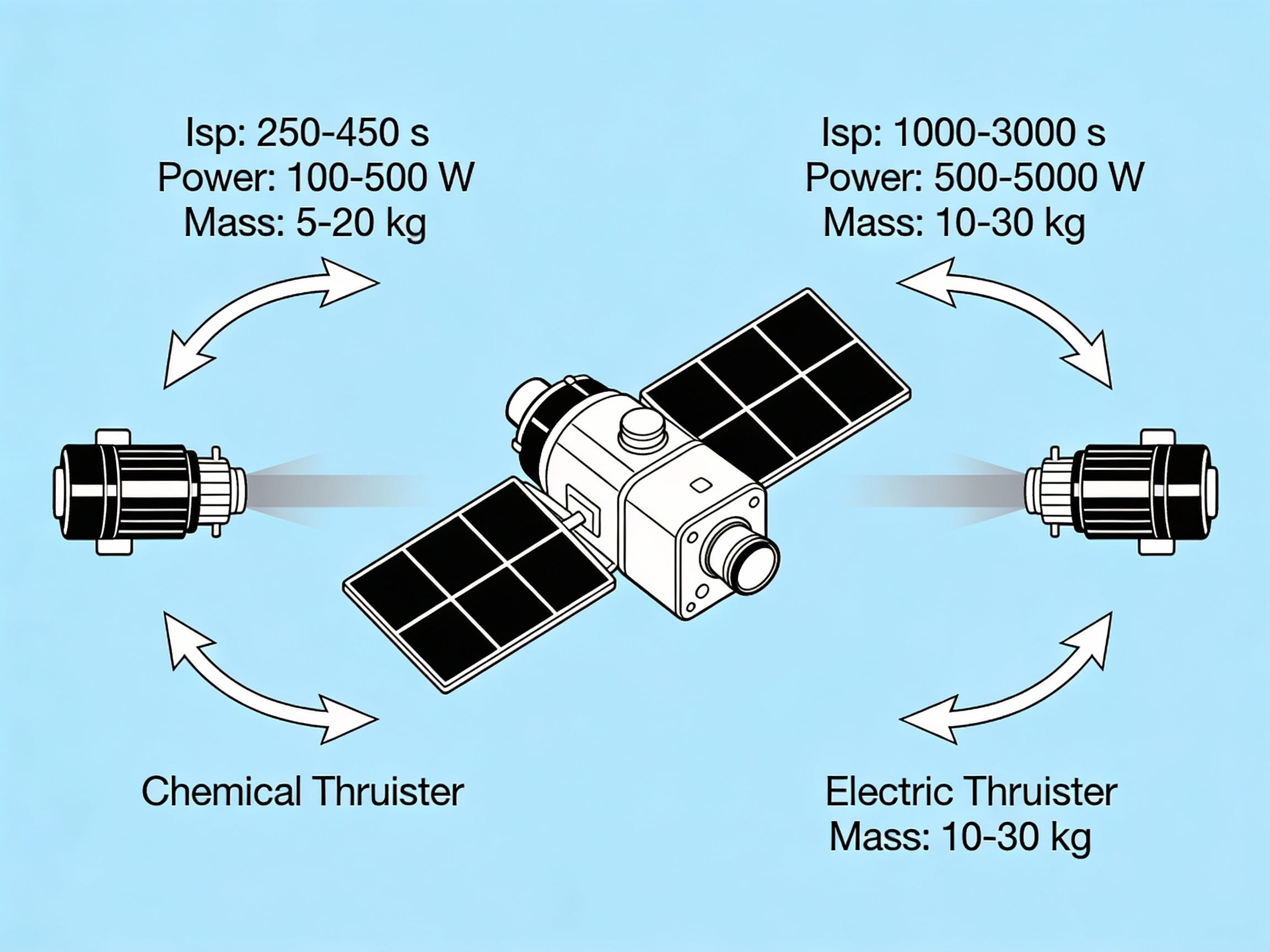
This thesis develops a structured database and decision tool for thruster selection in small satellite missions, with a focus on electric and chemical propulsion options for LEO constellations. You will gather data on representative thrusters, structure it in a queryable form, and design selection logic that recommends suitable options based on mission delta‑v, power, mass, and operational constraints.
The work is well suited for students in Elektromobilität, Maschinenbau, or Informatik who enjoy combining propulsion basics with data modeling and software tools.
Mini demo challenge (attach repo link in your application):
Build a minimal thruster selection prototype that:
-
Stores 5–10 example thrusters (type, thrust, Isp, power, mass, TRL) in a machine‑readable format (JSON/CSV or a tiny database).
-
Provides a simple CLI or script that, given required delta‑v and available power, filters infeasible thrusters and ranks the feasible ones by a simple score (e.g. mass or propellant efficiency).
-
In the README, explain:
-
Why you chose your data format and parsing/CLI framework,
-
How you would scale this to a much larger catalog and richer selection criteria.
-
The demo is intentionally small; what matters is your tool and data modeling choices.
Suggested reading:
-
“Electric propulsion methods for small satellites: a review”, University of Stuttgart.
-
Hofer, R. et al., “Electric Propulsion for Small Satellites: A Case Study”, IEPC.
Application:
Interested candidates should submit their application to julius.pinsker@faps.fau.de including:
-
Current transcript of records (grades).
-
A concise CV (1 page).
-
A link to the mini demo repository described above.
I look forward to receiving your innovative applications.