
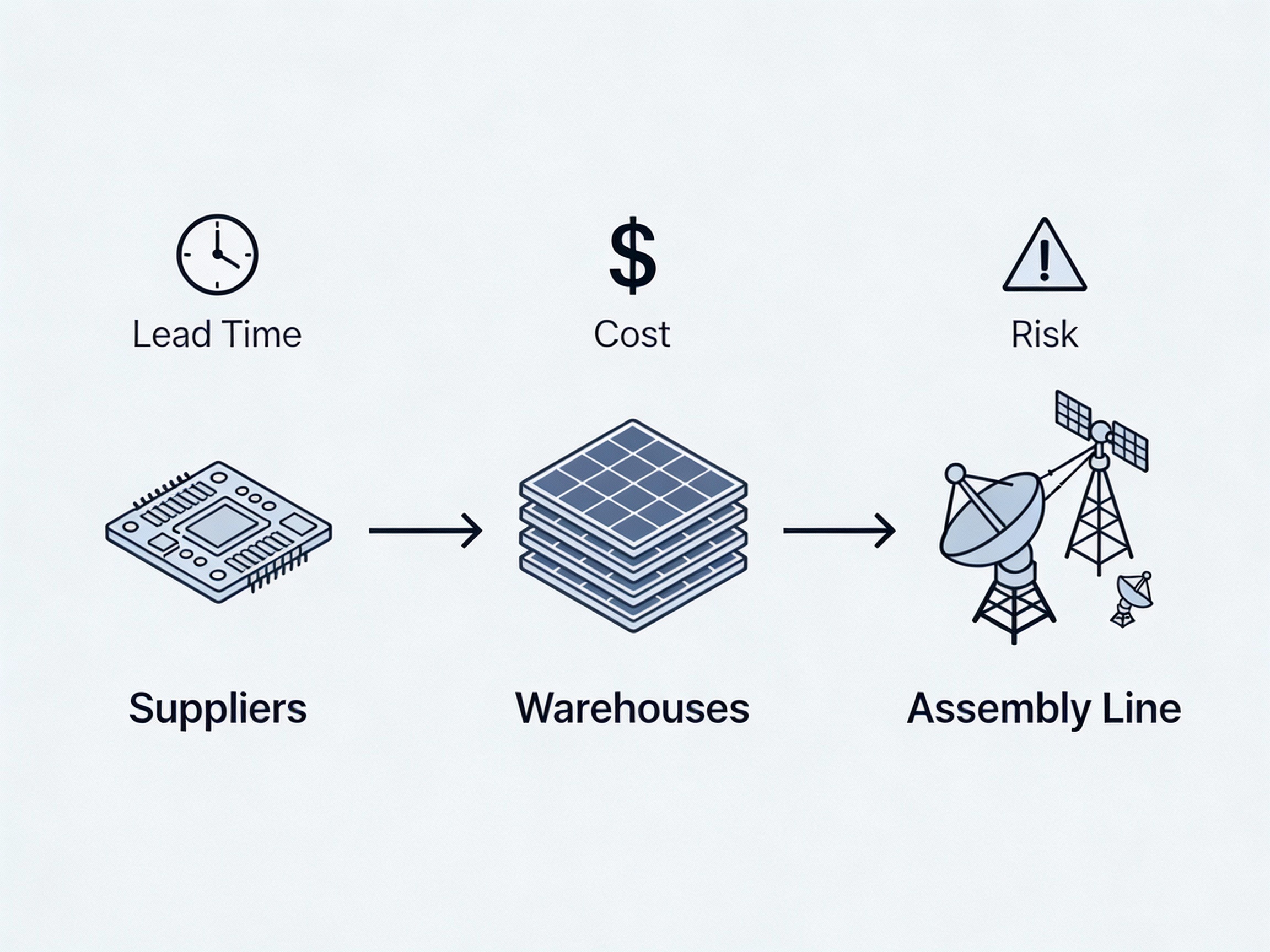
This thesis addresses supply chain optimization for CubeSat and small satellite components, considering lead times, minimum order quantities, cost, and obsolescence risk. You will formulate procurement models that match constellation build schedules with supplier capabilities and explore strategies to reduce risk and cost through better sourcing, buffering, and standardization.
The topic is especially suitable for Wirtschaftsingenieurwesen and Informatik students who enjoy combining optimization, data handling, and real‑world industrial constraints.
Mini demo challenge (attach repo link in your application):
Develop a tiny procurement planner that:
-
Defines a toy bill of materials with a few subsystems and 2–3 suppliers per component (different costs, lead times, and MOQs).
-
Computes a feasible procurement plan that meets a specified assembly start date while minimizing total cost (simple heuristic or small optimization model).
-
In the README, describe:
-
Your data modeling choices (formats, libraries),
-
Why you chose a particular solver or heuristic approach,
-
How you would incorporate uncertainty in lead times or supplier failure.
-
The demo is designed to see how you structure a constrained planning problem and select appropriate libraries and solvers.
Suggested reading:
-
NASA NEPP, “CubeSat Parts Lists and Supply Chain”, ETW 2015 presentation.
-
NanoAvionics, “Navigating CubeSat and Small Satellite Procurement”.
Application:
Interested candidates should submit their application to julius.pinsker@faps.fau.de including:
-
Current transcript of records (grades).
-
A concise CV (1 page).
-
A link to the mini demo repository described above.
I look forward to receiving your innovative applications.
Kategorien:
Forschungsbereich:
Engineering-SystemeArt der Arbeit:
Bachelorarbeit, MasterarbeitKontakt:
Julius Pinsker, M.Sc
Lehrstuhl für Fertigungsautomatisierung und Produktionssystematik (FAPS, Prof. Franke)
Engineering-Systeme
- E-Mail: julius.pinsker@faps.fau.de