
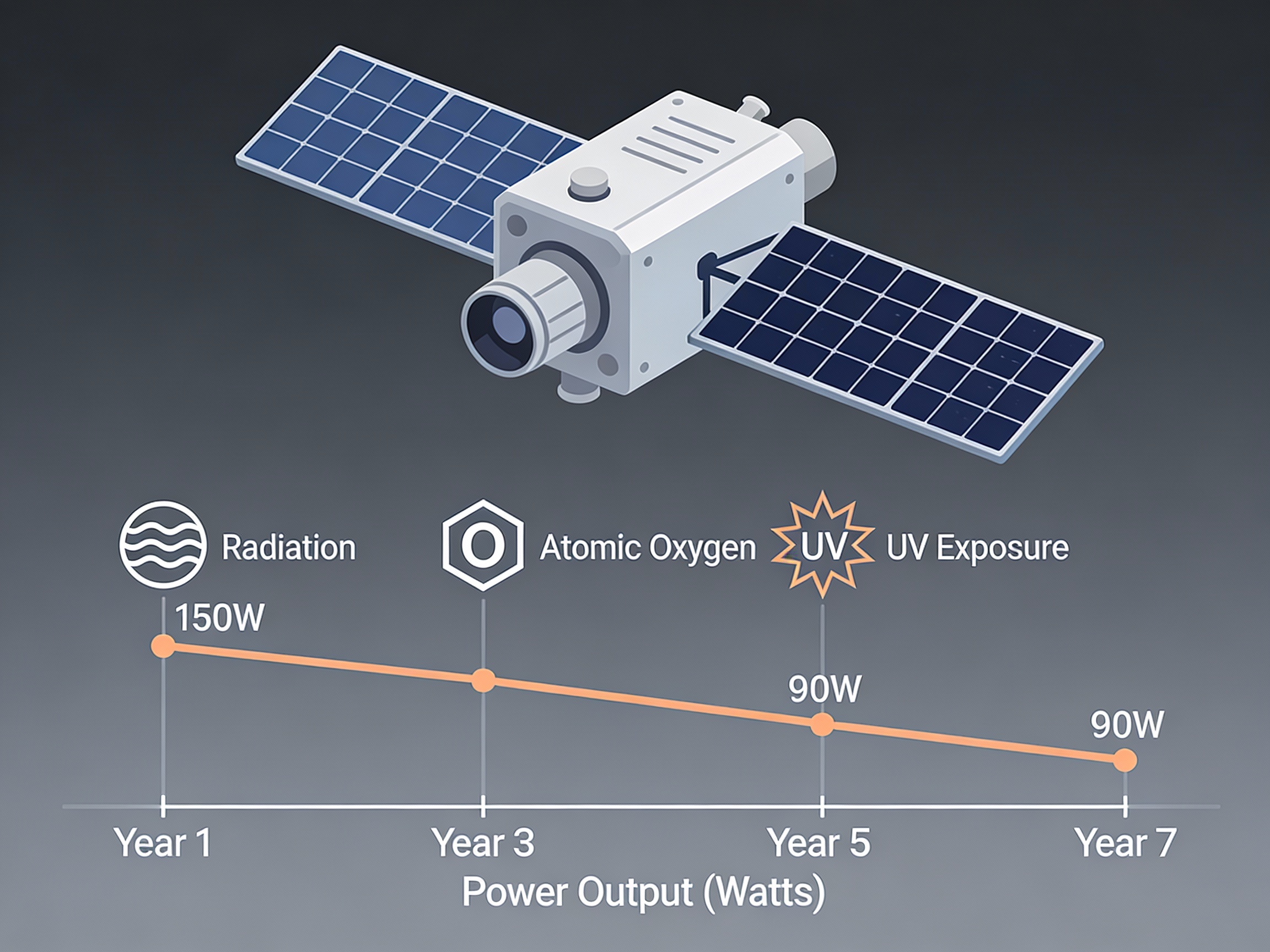
This thesis investigates how solar arrays degrade in the LEO environment due to radiation, atomic oxygen, and UV exposure, and how this affects end‑of‑life power budgets for small satellites and constellations. You will combine environment models with degradation data to build simplified yet credible lifetime models for different technologies and orbits.
The work can range from a more physics‑ and data‑oriented study (matching telemetry and literature data) to integration into an existing power sizing tool. Students from Energietechnik, Maschinenbau, or Informatik with interest in numerical modeling are welcome.
Mini demo challenge (attach repo link in your application):
Implement a small degradation model that:
-
Starts from an initial solar array power and applies simple yearly degradation factors combining a constant term and an altitude‑dependent radiation term.
-
Computes and plots relative power over 5–10 years for at least two LEO altitudes (e.g. 400 and 700 km).
-
In the README, briefly describe your assumptions and explain why you chose particular numerical and plotting libraries.
The demo should be small but clean, showing how you structure a quantitative degradation study.
Suggested reading:
-
Summers, G.P. et al., “Radiation-Induced Power Degradation for GaAs/Ge Solar Arrays”, SmallSat Conference.[digitalcommons.usu]
-
“Evaluation and prediction of the degradation of space Si solar cells under complex space environment”.[zgwlc.xml-journal]
Application:
Interested candidates should submit their application to julius.pinsker@faps.fau.de including:
-
Current transcript of records (grades).
-
A concise CV (1 page).
-
A link to the mini demo repository described above.
I look forward to receiving your innovative applications.
Kategorien:
Forschungsbereich:
Engineering-SystemeArt der Arbeit:
Bachelorarbeit, Masterarbeit, ProjektarbeitKontakt:
Julius Pinsker, M.Sc
Lehrstuhl für Fertigungsautomatisierung und Produktionssystematik (FAPS, Prof. Franke)
Engineering-Systeme
- E-Mail: julius.pinsker@faps.fau.de